The Rise of Agentic Enterprises: AI Automation Trends Reshaping Business Decisions in 2026
Meta description: Explore AI automation trends in 2026 as agentic enterprises let AI agents make real business decisions — opportunities, risks, and next steps.
Introduction: The Day the Software Stopped Waiting for Permission
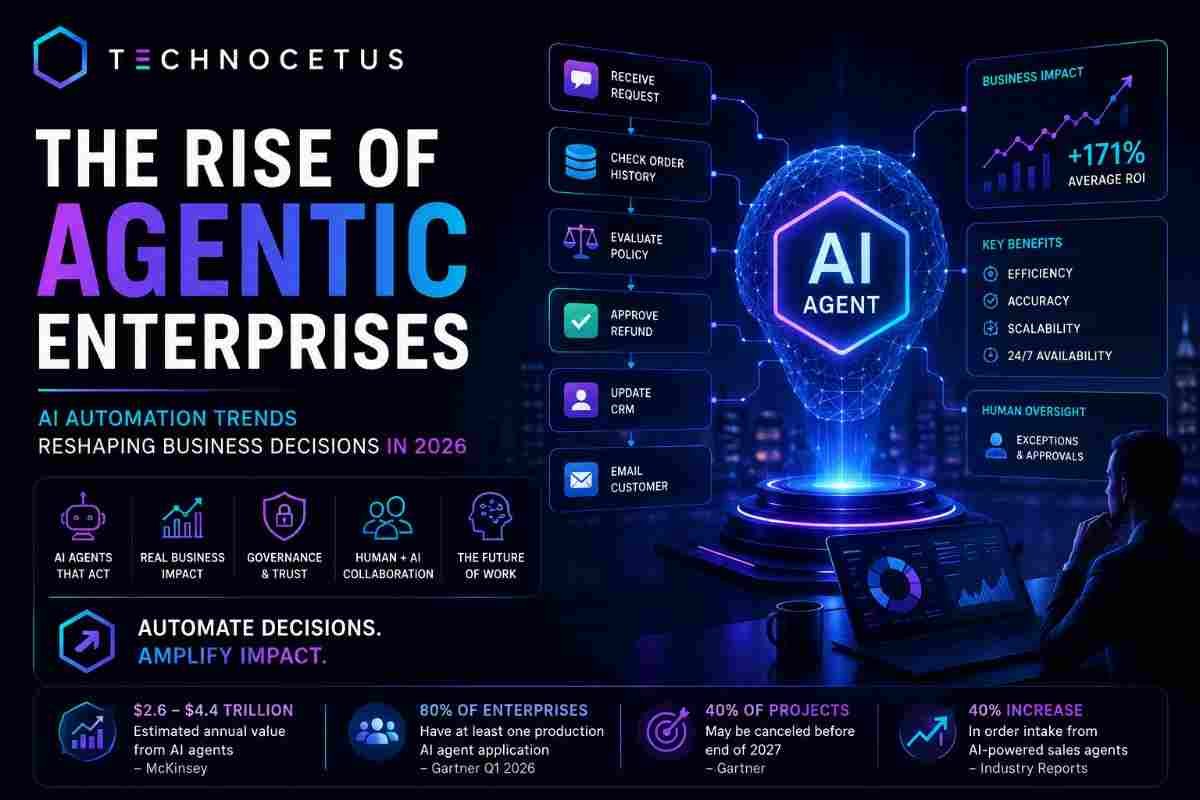
Picture a customer service ticket landing at 2 a.m. Ten years ago, it sat in a queue until a human logged in. Five years ago, a chatbot might have answered a simple FAQ. Today, an AI agent reads the ticket, checks the order history, approves a refund within policy limits, updates the CRM, and emails the customer — all before sunrise, with no human in the loop.
This is the quiet revolution behind the phrase "agentic enterprise": organizations where AI doesn't just assist with tasks, it decides and acts on them. It's one of the defining artificial intelligence trends of 2026, and it's forcing business leaders to rethink what automation, oversight, and even leadership itself mean.
What Makes an Enterprise "Agentic"?
Traditional software follows rules. Generative AI produces content when asked. Agentic AI is different — it plans, reasons across multiple steps, calls external tools, and keeps track of a task's state over time without constant human prompting.
Analysts frame the shift as a market inflection point. The global agentic AI market is estimated to have surged past several billion dollars in 2026, and <cite index="4-1">Gartner predicts up to 40% of enterprise applications will include integrated task-specific agents by 2026, a sharp rise from less than 5% the year before</cite>. In practice, that means the software your team already uses — CRMs, ERPs, ticketing systems — is quietly gaining the ability to act on your behalf.
Key characteristics of agentic systems:
- Autonomy — they complete multi-step workflows without a human clicking "next" at every stage
- Tool use — they query databases, call APIs, and trigger other software
- Memory and state — they track where a task stands across hours or days
- Goal orientation — they're given an outcome, not just a script
Why This Matters Now: From Pilot Projects to the Boardroom
For years, AI in business meant pilot programs — a chatbot here, a recommendation engine there. That era is ending. <cite index="6-1">Gartner's Q1 2026 survey found that 80% of enterprises now report at least one production application with an embedded AI agent, up from 33% just two years earlier</cite>.
The financial case is a big part of the story. <cite index="1-1">McKinsey estimates AI agents could add between $2.6 and $4.4 trillion in value annually across business use cases</cite>, spanning customer service, finance, and operations. Some deployments are already showing measurable returns: <cite index="7-1">enterprise agentic AI deployments are reportedly generating average returns near 171%, with U.S. organizations seeing figures closer to 192%</cite> — well above what traditional automation projects typically deliver.
It's no surprise, then, that <cite index="2-1">a recent CEO survey found roughly a third of chief executives now name AI as their top strategic priority, overtaking digital transformation as the boardroom's central theme</cite>. AI automation and business transformation have merged into a single conversation.
Real-World Applications Emerging in 2026
Agentic AI isn't confined to one department. Here's where it's showing up most:
- Customer operations — agents resolving tickets, processing refunds, and escalating only edge cases to humans
- Sales and revenue — <cite index="5-1">organizations report AI-powered sales agents contributing to 40% increases in order intake and a doubling of prospecting activity</cite>
- Finance and procurement — agents reconciling invoices, flagging anomalies, and negotiating routine contract terms, cutting cycle times dramatically
- Software engineering — coding agents that open pull requests, fix bugs, and run tests against live repositories
- Knowledge management — agents synthesizing reports and maintaining institutional memory across scattered systems
Think of it like the shift from a single skilled assistant to a small, tireless team that never sleeps, never forgets a step, and reports back only when something genuinely needs a judgment call. That's the practical promise of machine learning-driven agents layered on top of generative AI foundations.
A useful analogy: the autopilot, not the airplane
Agentic AI functions less like a fully autonomous system replacing pilots and more like a sophisticated autopilot: it handles the routine flight path — altitude, heading, fuel trim — freeing the human crew to focus on judgment calls, exceptions, and the moments that truly require experience. The best-run agentic enterprises keep a human in that captain's seat, even as more of the flight runs on autopilot.
For teams weighing where automation fits their workflow, see our guide on RPA tools for a comparison of rules-based automation versus agentic decision-making.
The Challenges: Ethics, Bias, and the Governance Gap
Adoption is racing ahead of oversight, and that gap is the industry's biggest open question.
- Bias and fairness: Agents trained on historical data can encode and amplify existing biases, especially when making decisions like loan approvals or hiring recommendations — decisions that used to have a human sanity-check built in.
- Accountability: When an autonomous agent makes a costly mistake, who is responsible — the vendor, the deploying company, or the team that approved the workflow? Regulatory frameworks are still catching up.
- Reliability and failure rates: Not every initiative succeeds. <cite index="3-1">Gartner projects that around 40% of agentic AI projects could be canceled before the end of 2027</cite>, often due to unclear ROI, poor data foundations, or unrealistic scope.
- Security: Agents that can call tools and move data across systems widen the attack surface. Giving software the ability to act — not just answer — raises the stakes of a compromised system.
- Change management: <cite index="2-1">Despite the urgency, McKinsey's research suggests the vast majority of enterprises have not yet achieved true AI maturity, meaning the technology often outpaces the organizational structures meant to govern it</cite>.
None of this means enterprises should pump the brakes entirely — it means governance has to be built in from day one, not bolted on afterward.
Opportunities Hiding in the Disruption
The organizations pulling ahead aren't necessarily the ones with the flashiest agents — they're the ones treating agentic AI as an operating model, not a feature.
- Compounding advantage: Early movers who establish solid agent infrastructure accumulate data and process experience that's difficult for latecomers to replicate quickly.
- Interoperability standards: Open protocols for connecting agents across vendors are gaining traction, with a meaningful share of enterprise software vendors expected to support them in 2026 — a sign the ecosystem is maturing beyond single-vendor silos.
- New job categories: Roles like AI orchestration lead, agent auditor, and prompt/workflow architect are emerging to fill the governance gap.
- The future of work is shifting, not disappearing: Routine decision-making is moving to agents, while human judgment concentrates on exceptions, strategy, and relationship-driven work.
Actionable Takeaways for Business Leaders
If you're weighing how — or whether — to move your organization toward agentic operations, consider these steps:
- Start with a narrow, high-volume workflow. Ticket triage, invoice matching, or routine reporting are lower-risk places to prove value before expanding scope.
- Build governance before you scale, not after. Define who reviews agent decisions, how errors get caught, and what "human-in-the-loop" checkpoints stay in place.
- Invest in data quality first. Agentic systems inherit the blind spots of the data and rules they're given; clean, well-labeled data is the real bottleneck, not model sophistication.
- Measure beyond cost savings. Track cycle time, error rates, and employee time reclaimed — not just headcount reduction — to get an honest read on ROI.
- Train people to supervise, not just to use. The most valuable skill in an agentic enterprise isn't prompting; it's knowing when to intervene.
Final Thought
The rise of agentic enterprises isn't a distant forecast — it's already reshaping how tickets get resolved, contracts get reviewed, and code gets shipped. The businesses that will benefit most won't be the ones that hand over the keys entirely, but the ones that thoughtfully decide which decisions belong to machines, which stay with people, and how to keep that boundary honest as the technology keeps moving.
For a deeper look at the data behind these shifts, see Gartner's newsroom coverage of enterprise AI agent forecasts at gartner.com.
SEO Metadata
Suggested SEO Title: The Rise of Agentic Enterprises: AI Automation Trends 2026
Meta Description: Discover how AI automation trends in 2026 are creating agentic enterprises — where AI agents make real business decisions. Risks, ROI, and next steps.
Recommended Keywords:
- AI automation
- agentic AI / agentic enterprise
- generative AI
- business transformation
- future of work